

- S3/520 Collins St, #1191, Melb. VIC 3000, Australia
- info@aassurecomply.com
- +61 (03) 8488 7406
Tunisia eInvoicing For Connected Finance Teams
AassureComply helps Tunisian businesses manage e-Invoicing workflows, DGI-ready invoice data, TVA controls, ERP integration and audit-ready records.
GCC Trusted Compliance Coverage
- FTA-Compliant Workflows
- UAE VAT Ready
- Arabic UI Support
- GCC Entity Support
- Audit Trail Enabled
- ERP Integration
Five Controls For Tunisia Compliance Operations
AassureComply connects the core controls Tunisian teams need before, during and after invoice processing.
What You Can Manage
Invoice Data Control
Capture buyer, supplier, TVA, tax identifier, invoice and entity details in a structured workflow.
DGI Workflow Support
Prepare, validate, track and manage invoice records through DGI-ready processes.
TVA And Code Mapping
Map TVA, item, customer, supplier and ERP codes into cleaner invoice data.
Finance Governance
Control approvals, user access, entity activity, corrections and audit evidence.
Compliance Visibility
Track failed validations, pending invoices, corrected records and exchange activity centrally.
Built For Tunisia’s Real Invoice Scenarios
Tunisia invoice compliance goes beyond issuing a standard sales invoice. Businesses may need structured invoice records, TVA-ready credit notes, customer tax identifiers, supplier invoice review, Arabic or French invoice details, ERP data mapping and multi-entity visibility across branches. Manual handling increases risk. AassureComply turns these scenarios into structured, traceable and auditable workflows.
Common Tunisia Workflows Supported
DGI-ready invoice workflows with required tax and party details captured correctly.
TVA invoice handling for sales, purchases, credit notes and adjustments.
Customer and supplier tax identifier management across invoice records.
Supplier invoice receiving with validation, review and approval workflows.
Cross-border transactions involving foreign suppliers, services or imported goods.
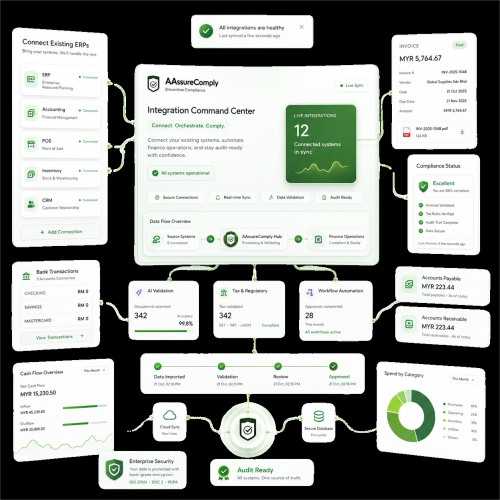
Connect ERPs, POS And Accounting Systems
AassureComply is designed to sit around the finance systems Tunisian teams already use. No full ERP rebuild. No repeated manual uploads. No disconnected compliance layer. Connect invoice, buyer, supplier, product, TVA and entity data from ERP, POS, accounting and custom business systems into one Tunisia compliance workflow.
GCC-Friendly Controls
- Support Arabic interfaces for UAE finance and operations teams.
- Manage invoice workflows across UAE entities and branches.
- Track invoice validation, tax issues and reporting status centrally.
- Connect supplier, invoice and tax data into compliance workflows.
Integration Areas







Built For Tunisia SMEs And CFOs
AassureComply helps Tunisian businesses manage invoice compliance through structured finance workflows.
For Tunisia SMEs
Reduce manual invoice checks and TVA workflow uncertainty.
Prepare for e-Invoicing workflows without replacing existing systems.
Manage tax identifiers, supplier records and approvals.
For CFOs
Improve visibility across invoice status, TVA fields and reporting risk.
Track compliance gaps across entities, branches and finance teams.
Keep audit-ready records for tax, finance and management reviews.
Frequently Asked Questions
What is Tunisia e-invoicing compliance?
Tunisia e-invoicing compliance means preparing and managing electronic invoice data according to Tunisia’s applicable tax and electronic invoicing requirements. Depending on the workflow, businesses may need structured invoice records, correct TVA treatment, tax identifiers, electronic signing and transmission through the national e-invoicing environment. Finance teams should maintain accurate, traceable invoice information and supporting records throughout processing and reporting.
How does e-invoicing work in Tunisia?
E-invoicing in Tunisia uses a structured electronic invoicing framework connected to the national El Fatoora environment operated by Tunisie TradeNet. Businesses prepare invoice data, apply the required tax and identification information, and follow the applicable electronic submission process. The workflow is designed to create traceable electronic invoice records rather than relying only on ordinary PDF invoices sent by email.
What data is required for Tunisia e-invoicing?
Tunisia e-invoicing requires businesses to maintain accurate invoice data such as supplier and customer details, tax identifiers, TVA treatment, invoice values, document references and other mandatory transaction information. Finance teams should validate these fields before submission so invoice records remain complete, consistent and traceable. Strong data quality also helps reduce processing errors across ERP, accounting and compliance workflows.
How does Tunisia e-invoicing handle TVA and tax codes?
E invoicing in Tunisia requires finance teams to apply the correct TVA treatment and tax information to relevant transactions. Businesses need consistent tax coding across sales, purchases, credit notes and adjustments so invoice records reflect the appropriate treatment. AassureComply can help structure TVA codes and tax mappings within connected workflows, giving teams clearer control over invoice data and finance review processes.
Can AassureComply connect Tunisia e-invoicing with ERP, POS and accounting systems?
Yes. AassureComply can connect Tunisia e-invoicing workflows with ERP, POS and accounting systems so invoice data, tax codes, customer records and approval information move through connected finance processes. Integration helps reduce duplicate entry and disconnected workflows while allowing businesses to retain existing finance systems and add structured electronic invoicing, validation and compliance controls around them.
How can Tunisia e-invoicing software help SMEs and CFOs?
Tunisia e-invoicing software can help SMEs reduce manual invoice checks and improve consistency across tax, approval and reporting workflows. CFOs can gain better visibility into invoice status, TVA fields, validation issues and finance controls. A connected platform also helps teams manage compliance evidence, review exceptions and maintain clearer records across entities, branches and accounting processes.
How should businesses validate e-invoices in Tunisia?
Businesses should validate e-invoices in Tunisia before processing by checking invoice values, customer and supplier details, tax identifiers, TVA treatment, document references and required transaction fields. Validation helps identify missing or inconsistent data before it moves further through accounting or compliance workflows. Finance teams should also review corrections and exceptions so invoice records remain accurate, traceable and suitable for reporting.
Can AassureComply support cross-border and multi-entity invoicing in Tunisia?
Yes. AassureComply can support businesses managing Tunisia e-invoicing alongside cross-border transactions, multiple entities, suppliers and finance teams. The platform can help structure invoice data, tax treatment, approvals and supporting records across different workflows while maintaining clearer visibility at entity level. This is useful for organizations that need consistent finance controls without forcing every branch or business unit into identical operational processes.