


PEPPOL Pricing Based On Your Setup
Pricing depends on countries, document volume, entities, integrations and onboarding requirements for your setup.
Connect to the PEPPOL network, exchange structured invoices and manage delivery across supported markets with audit-ready records.
AassureComply helps teams control what happens before, during and after every PEPPOL document exchange workflow. A PEPPOL Access Point should not only move documents from one participant to another. Finance teams need confidence that invoice data is complete, routing details are correct, exceptions are visible and every exchange can be traced later. AassureComply gives businesses the controls needed to manage PEPPOL e-invoicing as part of a wider compliance workflow, not just as a technical connection.
Validate invoice data, sender details, receiver information, tax fields and document structure before submission.
Route PEPPOL documents through controlled workflows with status visibility, exception alerts and delivery tracking.
Keep validation history, delivery responses, timestamps and audit records connected to each document.
Reduce uncertainty around invoice status, failed submissions, supplier responses and compliance evidence.
Connect PEPPOL workflows with existing systems without rebuilding the full finance stack.
AassureComply helps teams manage PEPPOL invoice exchange across multiple countries from one compliance workflow.
Add supported countries after coverage is verified by product and compliance teams.
Structured invoice readiness for XRechnung and PEPPOL-related workflows.

InvoiceNow and PEPPOL support for GST-compliant invoice exchange.

PEPPOL e-invoicing for compliant supplier and customer exchange.

PEPPOL e-invoicing for business and public sector compliance.

Cross-border PEPPOL workflows for ANZ finance and compliance teams.
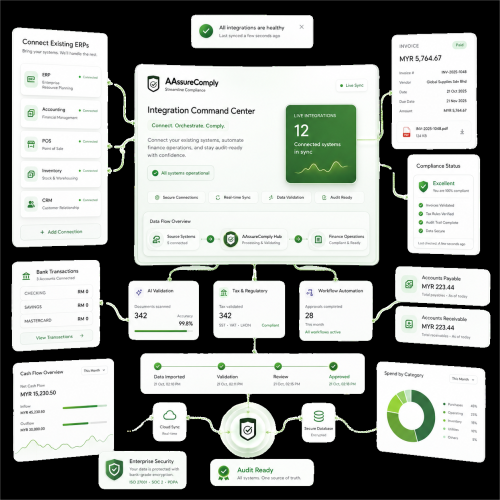
PEPPOL onboarding should not feel vague. AassureComply gives teams a clearer path from setup to go-live.
Confirm entities, countries, invoice volume and required PEPPOL workflows.
Configure PEPPOL participant IDs, sender details and receiver information.
Connect ERP, accounting, POS, API or invoice data sources.
Run test invoices, validate formats and confirm routing before go-live.
Move from testing to live PEPPOL document exchange with status tracking.
Pricing depends on countries, document volume, entities, integrations and onboarding requirements for your setup.
A PEPPOL Access Point is a certified connection that allows businesses to send and receive structured electronic documents across the Peppol network. It acts as the secure gateway between a company’s finance system and other registered participants, supporting document routing, validation, delivery status and exchange records for e-invoices and other supported business documents.
A PEPPOL Access Point connects a sender’s business system to the Peppol network, identifies the receiving participant, validates the required document information and routes the structured document to the recipient’s Access Point. The receiving system can then process the document within its own finance workflow. This model enables interoperable electronic document exchange between businesses using different ERP or accounting platforms.
A PEPPOL Access Point provider should offer secure document exchange, invoice validation, reliable delivery tracking, ERP integration, technical support and clear audit records. Businesses should also review onboarding requirements, API capabilities, supported document types and country coverage. For multi-entity organizations, the provider should be able to support scalable workflows across different companies, systems and operating markets.
A PEPPOL Access Point provider specifically provides connectivity to the Peppol network for sending and receiving structured documents. A broader PEPPOL service provider may also offer services such as integration, invoice validation, participant discovery, workflow automation and compliance support. Businesses should compare the actual capabilities included rather than assuming every Peppol provider offers the same technical and operational services.
Yes. A PEPPOL Access Point can integrate with ERP, accounting, billing and finance systems through APIs or other supported integration methods. This allows structured invoices and related document data to move between internal systems and the Peppol network without relying on manual re-entry. Integration can also connect validation results, delivery status, exceptions and audit information with existing finance workflows.
Yes. A PEPPOL Access Point can support both sending and receiving structured Peppol e-invoices, depending on the provider’s configured services and document workflows. Businesses can use the connection to exchange invoice data with registered trading partners while maintaining structured routing, validation and delivery records. This helps finance teams manage electronic invoicing within connected accounting and compliance processes.
Businesses participating in PEPPOL e-invoicing typically connect to the network through an approved Access Point rather than exchanging documents directly with every trading partner. The Access Point provides the network connection, routing and document exchange services needed for interoperability. The exact onboarding and compliance requirements can vary by country, trading relationship and the Peppol framework used in that market.
PEPPOL Access Point onboarding time depends on the business systems involved, participant setup, document requirements, integrations, testing and number of entities being connected. A simple setup may require fewer technical steps than a multi-country ERP integration. Businesses should review participant registration, invoice mappings, API connectivity, testing scenarios and production requirements with the provider before setting an implementation timeline.