

- S3/520 Collins St, #1191, Melb. VIC 3000, Australia
- Email Us
- +61 (03) 8488 7406
Connect ERP Systems With Philippine E-Invoicing
Integrate ERP systems, automate invoice exchange, configure tax mappings and improve BIR readiness through connected APIs.
Integration Trust Badge Row
- ERP Integration Ready
- E-Invoicing API
- Tax Code Mapping
- BIR Readiness
- Multi-System Connectivity
- Integration Audit Trails
Connect ERP Systems And Invoice Workflows
Disconnected ERP systems create invoice data inconsistencies, manual reconciliation work and limited visibility into electronic invoicing processes. AassureComply provides e invoicing integration Philippines businesses can evaluate for connecting financial systems, standardizing invoice data and managing exchange workflows. Its integrated approach helps finance teams reduce manual errors, improve data accuracy and maintain consistent electronic invoicing processes across business systems.
ERP And Invoice Integration Capabilities
ERP Connectivity
Connect ERP invoices with structured electronic processing workflows.
API Integration
Exchange electronic invoice data through configurable application interfaces.
Tax Mapping
Align ERP tax codes with invoice data classifications.
Data Synchronization
Synchronize customer, supplier and entity information across systems.
Response Monitoring
Track invoice responses, integration failures and transaction exceptions.
Validate Invoice Data Before Electronic Exchange
AassureComply helps finance and IT teams identify invoice data inconsistencies before information enters downstream processing workflows. Structured validation supports accurate field mapping, consistent tax classifications and clearer visibility into integration exceptions.
Invoice Data Validation Controls -
Validate invoice fields before transferring data between systems.
Identify missing tax mappings and inconsistent transaction classifications.
Track failed API requests and unresolved invoice exceptions.
Maintain integration logs for investigations and compliance reviews.
Reduce manual corrections across ERP and invoice workflows.
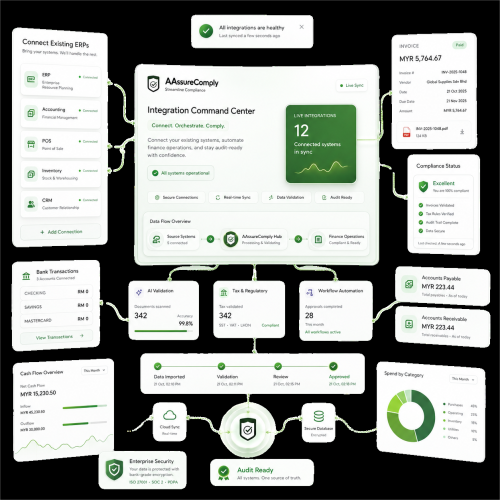
Integrate SAP And Other ERP Platforms
AassureComply supports erp e invoicing integration through structured APIs, configurable mappings and controlled invoice exchange workflows.
E-Invoicing Integration Controls
- Configure e invoicing api Philippines workflows for structured data exchange.
- Apply invoice tax code mapping across ERP invoice classifications.
- Evaluate sap e invoicing integration Philippines requirements and connectivity.
- Track failed transfers, mapping errors and unresolved processing exceptions.
Integration Areas








Support Finance Teams And Integration Owners
AassureComply helps finance and technical stakeholders coordinate invoice integration, maintain consistent data structures and monitor connected business workflows.
For ERP Finance Teams
Align invoice data across financial systems and accounting workflows.
Reduce manual tax mapping corrections and transaction reconciliation effort.
Monitor invoice processing exceptions across connected business applications centrally.
For IT And Integration Owners
Configure API connections without unnecessary ERP architecture changes.
Track integration failures, response statuses and processing errors centrally.
Maintain documented data mappings and traceable system exchange records.
Frequently Asked Questions
What is e-invoicing integration in the Philippines?
E-invoicing integration connects ERP, accounting and billing systems with electronic invoice workflows. It supports structured data exchange, validation, tax mapping and transaction monitoring while helping businesses prepare for applicable Philippine BIR requirements.
How does an e-invoicing API connect existing business systems?
An e-invoicing API allows applications to exchange invoice information through defined interfaces. It supports data extraction, field mapping, validation and processing responses, reducing repetitive transfers between financial systems.
Can AassureComply integrate with SAP for Philippine e-invoicing?
AassureComply supports integration-oriented workflows for SAP environments, including invoice extraction, data transformation and tax mapping. Specific SAP connectivity, supported modules and implementation requirements depend on the existing configuration.
How does invoice tax code mapping improve invoice accuracy?
Invoice tax code mapping connects ERP tax classifications with standardized invoice fields and VAT information. It helps identify incorrect mappings, reduce inconsistent transaction data and improve validation before further processing.
Does AassureComply support multiple ERP and accounting systems?
AassureComply supports integration workflows across ERP, accounting, POS and billing environments. Available connectivity depends on supported APIs, existing connectors, invoice structures and individual system requirements.
Can ERP integration support Philippine BIR e-invoicing compliance?
ERP integration can support BIR readiness through structured invoice data, validation and electronic exchange. Compliance also depends on applicable taxpayer obligations, system requirements and prescribed issuance or reporting processes.